Contemporary Dance Classes in Nottingham
Contemporary Nottingham
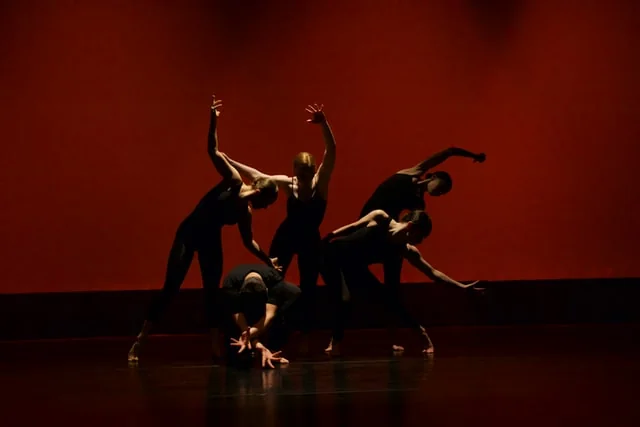 Contemporary — Nottingham
Class is coming soon
Send us your details for class news
Class Details
Location: Nottingham City Centre
Day: TBC
Time: TBC
Age Group: 17 – 75
Teacher: —
Class Structure
Beginners Class — 60 Minutes
Breath & Floor Warm-Up
Settling onto the ground with spinal rolls and long, unhurried breaths, coaxing the joints loose and listening to where weight and gravity want to take you.
Release & Contraction
Exploring release technique, the pull of contraction and the lift of suspension, along with the fall-and-recovery cycle that lends contemporary its grounded, flowing feel.
Travelling & Floor Work
Crossing the studio with spirals, changes of level, gentle elevations and ways down to and up from the floor, weaving upright and grounded movement into one line.
Phrase & Expression
Picking up a short set phrase and colouring it with intention, dynamics and real feeling so each step carries weight beyond the shape.
Improvisation & Unwind
A guided improvisation task to draw the hour together, followed by slow stretching and a quiet pause to let the body settle before you leave.
About Contemporary Dance Classes in Nottingham
Contemporary sits at the freest, most unguarded end of dance — a style that drops set positions in favour of breath, body weight and natural momentum. Our weekly contemporary classes in Nottingham are built around release technique, floor work, contraction and suspension and a healthy dose of improvisation, with everything pointing towards movement that holds emotion and means something. Practised barefoot or in socks, each hour grows a language of motion that feels just as personal as it is athletic.
Nottingham brims with performance, from the Theatre Royal and the Playhouse to the lively student scene shared by the University of Nottingham and NTU, yet a steady weekly contemporary class for adults outside of college has been a tricky thing to track down. Ours run from our studio in Nottingham city centre, a short stroll from Old Market Square and the Lace Market, drawing curious movers from across the city and in from Beeston, West Bridgford, Long Eaton and as far out as Derby and Mansfield. With the NET tram dropping you nearby, the class has quickly become a fixture for first-timers and for adults rediscovering dance after a long break — wherever you are starting from, it begins with you.
There is no flexibility requirement, no need for earlier training and no ideal body type — what counts is that you are game to discover how you move. Each idea is taught with clear anatomical guidance and plenty of creative latitude, letting craft and self-expression come on together. Turn up in soft, stretchy layers, barefoot or in socks. Browse the full set of 20 dance classes in Nottingham, or round up your friends for a one-off hen party dance class.
Ask About Contemporary Classes
Pop your details in below and we will keep you in the loop on days, times and the schedule.
What Contemporary Gives You
Move How You Feel
Contemporary gives you room to move out of emotion rather than into a set pose. Genuine craft sits underneath it, yet the point is sincere, personal expression that is nobody's but yours.
Strength From the Ground
Working down through the floor, suspending and catching yourself in recovery develops deep core strength, joint mobility and a body awareness that most gym routines never quite get to.
A Moving Meditation
Breathing into each phrase and improvising quietens a busy head, so the hour doubles as a release where you tune back into your body and walk out feeling lighter.
Tell a Story
More than anything, contemporary builds you into a performer — drawing out dynamics, living inside a stillness and giving a movement meaning, whether in front of a crowd or purely for your own sake.
Your Contemporary Dance Journey
From your earliest descent towards the floor through to dancing with honest emotion — this is how the path tends to open up.
Finding the Floor
Getting Started
Articulating the spine, shifting weight from side to side and making your first trips down to the ground and back. Working out how an exhale can kick off a movement, and how releasing tension and gravity team up.
What to Bring
Stretchy, snug clothing you can roll around in, and either bare feet or grip socks. Fix long hair up and skip the trainers so nothing catches as you travel across the studio.
Building Vocabulary
Developing Technique
Suspension and contraction, the back-and-forth of falling and recovering, spiralling and phrases that cover ground. Starting to sense how it is swing and drive, rather than force, that moves you through space.
First Improvisations
Easy opening tasks for inventing on the spot — responding to a picture, a single word or a scrap of sound — that build the nerve to choose your own movement with no script to fall back on.
Finding Expression
Longer Phrases
Stitching grounded work, standing material and gentle elevations into runs that carry across the room, and experimenting with range — sharp to smooth, dense to weightless, tight to open.
Emotional Storytelling
Tinting each move with purpose and emotion until a phrase plays out like a tale, and having your first go at building short ideas of your own with a handful of choreographic devices.
The Mover & Maker
Performing & Creating
Sure enough by now to read, invent and present movement, equipped to put your own phrases together, with an optional informal sharing to show what you have been working on.
What Comes Next
Pick up ballet to firm up your technique, dip into contact improvisation workshops, or look for performance ventures with dance collectives around Nottingham.
Contemporary Dance FAQ
The questions newcomers most often raise with us ahead of their first contemporary session.
Is contemporary something I can pick up in Nottingham as a complete newcomer? +
Of course. We pitch every class for a spread of abilities and break each idea down — a slow roll through the spine, a contraction, an easy sink towards the floor — into pieces you can practise and repeat. First-timers settle in quickly, and a good number of our dancers are grown-ups easing back into movement after years out of it.
How should I dress for rolling on the floor? +
Reach for soft, close layers that travel with you as you roll — leggings or joggers and a fitted top are ideal. The style is danced in bare feet or socks so you can catch and glide across the studio floor, so keep your trainers in your bag and pin any long hair up out of the way.
What does a contemporary dance class in Nottingham cost? +
A one-off drop-in is £10, and there is no joining fee or paperwork to sign. Prefer to commit? A four-week run is £32, which works each class down to £8. There is no contract and no membership behind any of it, so you just come along whenever the timetable suits your week.
Is contemporary dance tough going physically? +
It does draw on the body, though it always works to wherever you happen to be. The floor work, suspensions and travelling phrases grow your strength and stamina by degrees, and every exercise comes with a softer version so you can hold your own pace and never tip into strain.
Where in Nottingham do the contemporary classes run? +
Our weekly sessions are based at a studio in Nottingham city centre, a short walk from Old Market Square and the Left Lion and handy for the Lace Market and Hockley. With the NET tram and the station close by, it is a straightforward trip in from Beeston, West Bridgford and further afield. Ask us and we will point you to the right class.
Do I need to be flexible before I join? +
No — flexibility is something the practice grows in you, not a ticket you bring to the door. Contemporary cares far more about how you move within your own range, led by breath and intention, than about how far you can fold, and your mobility tends to ease open on its own as the weeks pass.
What can I expect during a contemporary class? +
We begin with a breath-led warm-up down on the floor, head into release technique and the contraction-and-suspension material, then cross the room with spirals and shifts of level. Each class wraps up with either a set phrase or a guided improvisation, so you get to mould the movement yourself and tell a little of your own story.
Release technique and floor work — what do they involve? +
Release technique means shedding the tension you hold and trusting breath and gravity to drive a movement rather than muscling it. Floor work brings that very idea right down to the ground — rolling, sliding and pressing back up so each link between moves feels fluid and grounded instead of rigid.
Will I be expected to improvise in front of the room? +
Only to the degree you are comfortable with. Improvisation arrives gently through small tasks — answering an image, a word or a piece of music — and you are never singled out or put on the spot. Plenty of people end up enjoying it more than any other part of the hour.
Are private contemporary sessions an option? +
We do. Private and small-group contemporary sessions can be set up whenever you ask, and they work nicely for going deeper into your release technique, refining a solo or assembling a piece for an audition. Tell us the goal you have in mind and we will build the sessions to match.
Fancy Exploring Contemporary Here in Nottingham?
Register your interest and we will send the latest contemporary timetable the moment it is set.
Get More Info →